
Staging Empty Properties for Sale
Transform Vacant Homes into Buyer Magnets

Empty properties present unique challenges. Without furniture and décor, vacant homes feel cold, impersonal, and difficult for buyers to envision living in.
Research shows empty properties lose up to 2% of their value monthly while on market. Yet empty properties also present advantages - blank canvas potential and clean presentation opportunity.
The solution: strategic empty property staging.
Research from 2025 data shows professionally staged empty properties sell 40–50% faster and command 8–12% price premiums compared to non-staged vacant properties.
This article explains empty property staging challenges, proven techniques that overcome them, and budget approaches for sellers with constraints.
Why Empty Properties Struggle to Sell
The Psychological Barrier
Buyers struggle to visualise furniture placement and scale in empty homes. Their brains can't easily picture how a space would feel lived-in. A completely empty room feels cold, echoey, and impersonal - the opposite of what buyers want to imagine.
Research from property psychology studies shows that 77% of agents agree staging makes it easier for buyers to visualise properties as future homes. For empty properties, this effect is even more pronounced.
The Value Perception Problem
Without furniture and soft furnishings, empty homes appear smaller, less welcoming, and potentially lower-quality. Buyers second-guess themselves: "If the space looked this empty, something must be wrong with it. Why hasn't anyone else bought it?"
The Market Positioning Challenge
Empty properties on market 90+ days accumulate negative perception. Buyers assume the property has issues. Market time beyond 12 weeks significantly reduces perceived value and buyer confidence. Empty properties become progressively harder to sell.
How Empty Properties Lose Value
Empty property value depreciation operates mathematically:
Month 1–3: Property positioned normally, values holding
Month 3–6: Slight buyer concern accumulates, viewing frequency declines
Month 6–12: Market perception negative, price reduction pressure begins
Month 12+: Significant value deterioration expected, buyer confidence low
A staged empty property maintains value perception throughout market time. An unstaged empty property risks 5–12% cumulative price reduction by month 12.
Core Empty Property Staging Principles
Principle 1: Minimalist Approach
Unlike sale staging for occupied homes, empty property staging uses minimal furniture. The goal isn't to fully furnish - it's to provide enough visual anchors that buyers can imagine themselves occupying the space.
Key insight: empty homes need suggestion of furniture, not complete furnishing. Too much furniture in empty rooms looks cluttered and limiting.
Principle 2: Focus on Key Rooms
Don't stage every room equally. Prioritise high-impact spaces where buyers form emotional connections:
Living room (primary gathering space)
Kitchen (major decision influencer)
Master bedroom (emotional anchor room)
Primary bathroom (lifestyle indicator)
Secondary spaces (guest bedrooms, studies, utility rooms) require minimal staging.
Principle 3: Highlight Spaciousness
Empty properties have advantage: obvious space. Strategic staging emphasises this advantage rather than fighting it.
Use minimal furniture positioned to show scale and flow. A single sofa in an empty living room demonstrates room size better than a completely furnished room would.
Principle 4: Create Visual Pathways
Guide buyer attention through the property strategically. Position key furniture pieces to create obvious traffic flow and visual hierarchy. Avoid random furniture placement.
Step-by-Step Empty Property Staging Guide
Step 1: Deep Clean and Prepare (£200–£500)
Start with spotless cleanliness. Empty properties show dirt and dust immediately without other visual elements to distract.
Pressure wash exterior
Deep clean windows (inside and out)
Clean all interior surfaces
Polish light fixtures
Ensure carpets/flooring spotless
Step 2: Minor Repairs and Painting (£300–£1,000)
Address obvious cosmetic issues:
Paint any dated or dark walls in neutral colours
Repair or replace outdated fixtures (taps, door handles)
Fix any obvious damage (holes in walls, damaged trim)
Ensure consistent finish throughout
Budget focus: high-visibility areas only.
Step 3: Minimal Living Room Staging (£500–£1,500)
Living room is buyers' primary emotional connection point. Stage minimally but effectively:
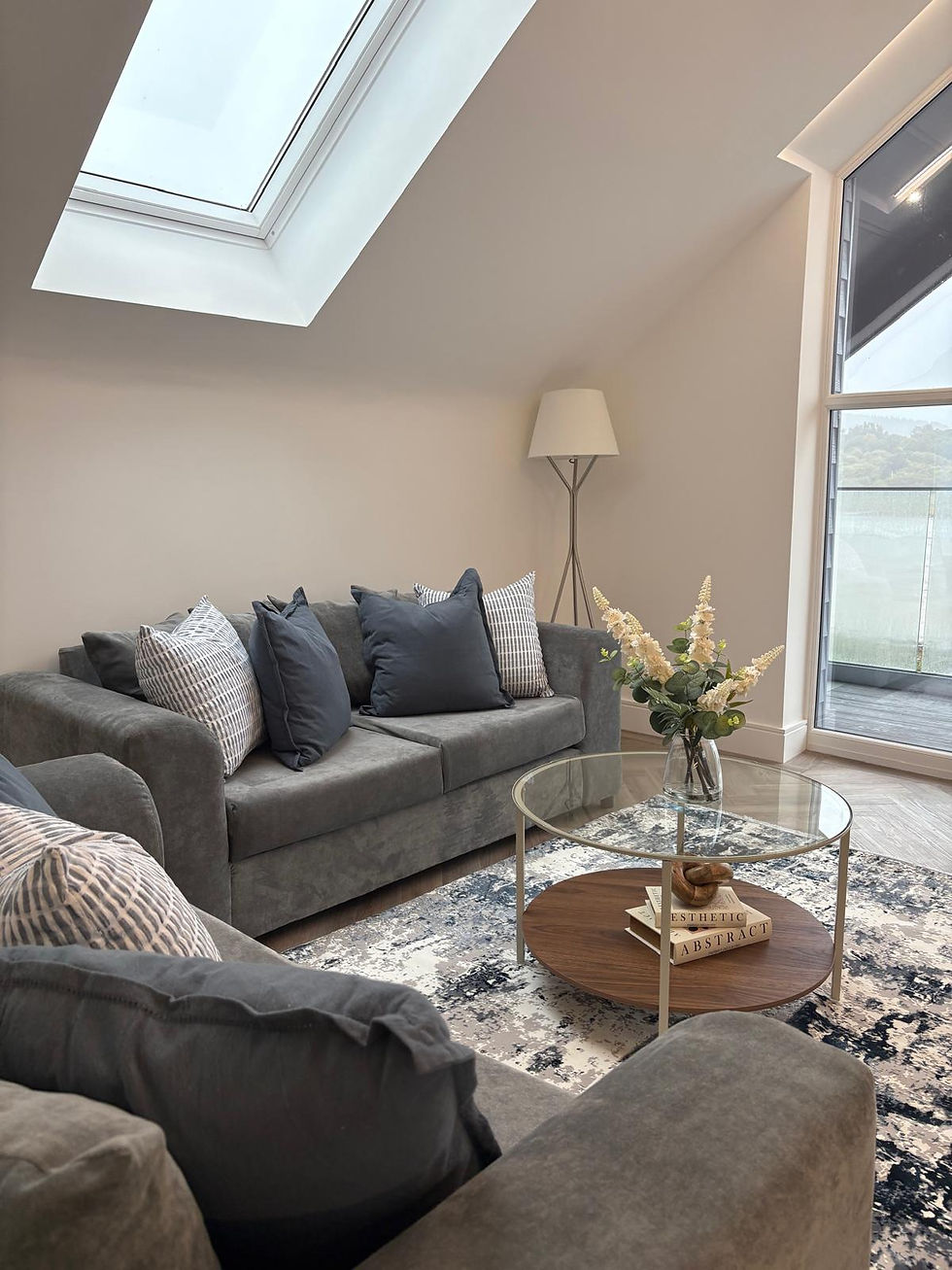
Sofa or seating arrangement (shows scale, invites imagining oneself sitting)
Coffee table (defines space, suggests functionality)
Lamp or lighting fixture (creates warmth, shows lighting potential)
Rug (defines floor space, adds colour and texture)
Optional: artwork or mirror (adds visual interest)
Key: Use minimal pieces. Open space is the advantage of empty properties.
Step 4: Master Bedroom Staging (£300–£800)
Master bedroom should feel restful and spacious:
Bed frame and bedding (essential for visualising bedroom use)
Bedside tables and lamps (suggests lighting and storage)
Minimal additional furniture (avoid clutter)
Quality bedding matters more than quantity. Good-quality neutral bedding conveys property value.
Step 5: Kitchen and Bathroom Staging (£200–£500)
Kitchens and bathrooms don't require staging furniture but need emphasised cleanliness and functionality:
Kitchen: spotless surfaces, clean appliances, perhaps fresh flowers
Bathroom: clean fixtures, quality towels (rolled and stacked neatly), fresh flowers or plant
Focus is cleanliness and brightness, not furniture.
Step 6: Lighting and Atmosphere (£200–£400)
Lighting dramatically affects how empty properties feel:
Maximum natural light: open all curtains/blinds fully
Add lamps throughout: standard lamps in corners, table lamps on furniture
Ensure all fixtures work and bulbs are quality (warm white, not harsh)
Consider subtle scent (fresh coffee brewing, fresh flowers)
Good lighting transforms cold empty spaces into warm, inviting homes.
Step 7: Professional Photography (£200–£400)
Photography is critical for online presentation. Professional photographs:
Show space in best light
Demonstrate scale and flow
Capture staging in professional composition
Generate more online views and viewing requests
Budget: £200–£400 for professional photography of empty property.
Budget-Conscious Empty Property Staging
Professional empty property staging averages £2,000–£8,000. Budget-conscious alternatives include:
The DIY Budget Approach (£500–£1,200)
Deep clean yourself or hire budget cleaner (£200–£400)
Paint essential rooms yourself (£100–£250)
Borrow furniture or source used pieces (£0–£300)
DIY or smartphone photography (£0–£100)
Expected result: 20–40% improvement in buyer appeal, achievable without professional stager.
The Minimal Professional Approach (£1,200–£3,000)
Professional deep clean (£300–£500)
Professional painter (2–3 rooms) (£400–£800)
Minimal furniture rental (£300–£800)
Professional photography (£200–£400)
Expected result: 60–80% of professional staging benefit, significantly more affordable.
The Full Professional Approach (£3,000–£8,000)
Professional stager consultation and design (£300–£600)
Complete furniture rental for entire property
Professional styling and accessories
Professional photography and videography
Extended staging period (4–12 weeks)
Expected result: Maximum buyer appeal, fastest sales, highest achieved prices.
Virtual Staging Alternative
Virtual staging digitally furnishes empty properties in photographs. Process:
Photograph empty rooms (buyer's standard smartphone quality acceptable)
Professional designer creates 3D renderings showing fully furnished spaces
Multiple virtual staging options provided
Use best renderings for online marketing
Virtual staging cost: £50–£300 per room
Advantage: affordable, allows multiple design option testing
Limitation: only works for online marketing; in-person viewing still shows empty space
Empty Property Marketing Strategies
Strategy 1: Highlight the "Clean Slate" Narrative
Market empty properties as "move-in ready" without previous wear. Message: "Blank canvas potential—imagine your vision in this space."
Target: Buyers seeking renovation projects or design-conscious buyers.
Strategy 2: Target Investor/Renovator Demographics
Empty properties appeal to investors and property developers. They visualise renovation potential. Marketing message: "Investor opportunity—development potential highlighted."
Target: Professional investors, property developers, renovation enthusiasts.
Strategy 3: Emphasise Cosmetic Readiness
If recently painted and cleaned, emphasise professional preparation. Message: "Freshly prepared and professionally cleaned—ready for immediate occupancy."
Target: Buyers seeking move-in ready properties.
Strategy 4: Strategic Pricing
Empty properties don't require price reductions. Instead, position realistically based on comparable sales. Buyers expect empty properties might require minor work—price accordingly, not as discount.
Real Example: Empty Property Staging Success
Property: Three-bedroom terraced house, empty 18 weeks, no offers.
Problem: Empty appearance, cold perception, buyer avoidance.
Solution:
Cost: £2,400 professional staging
Living room: sofa, coffee table, rug, lamp (furniture rental)
Master bedroom: bed, bedside tables (furniture rental)
Painting: living room, master bedroom (neutral whites/beiges)
Professional photography
Staging duration: 8 weeks
Result:
First viewing after staging: offer at 94% asking price
Time to offer: 3 days
Sale completed: 8 weeks
Sale price premium: £18,000 vs. likely achievable unstaged price
Staging ROI: 650%
When NOT to Stage Empty Properties
Staging may not be optimal if:
Property in poor structural condition: Staging cosmetics won't overcome structural concerns. Fix issues first, then stage.
Severe market oversupply: In extreme buyer's markets, staging ROI diminishes. Consider alternatives (auctions, quick sales).
Extremely tight budget: If staging cost exceeds 1% of property value and budget unavailable, may not be viable.
Very rapid sale needed: If property must sell within days, staging won't help (timeline too short).
Property sitting empty long-term: If no imminent sale plan, staging isn't cost-justified.
The Break-Even Calculation
Staging cost £2,000. Expected price premium: 8% on £250,000 property = £20,000.
Break-even point: You recover staging investment 10 times over through achieved price premium alone. Adding faster sale time (reduced carrying costs), virtually any staging investment pays for itself substantially.
Ready to Transform Your Empty Property?
Empty properties don't have to languish on market at discounted prices. Strategic staging transforms vacant homes into buyer magnets, generating faster sales and premium prices.
Whether you're staging a three-bedroom terraced house, a Victorian flat, or a modern apartment, the principles remain constant: minimalist staging, focus on high-impact rooms, professional photography, and strategic marketing.
Contact June Home Staging for a free consultation on staging your empty property. We'll assess your specific situation and recommend the approach that maximises your return on investment.


Comments